

Upstream Geology of Syria.
By Dr. Mohamed Basyouni
Abstract
Syria is located along the northern margin of the Arabian Plate and contains several sedimentary basins that have experienced complex tectonic and stratigraphic evolution from the Paleozoic to the Cenozoic. These basins host proven hydrocarbon accumulations, primarily within the Euphrates Graben and adjacent structural domains. This paper presents an integrated assessment of the upstream geological framework of Syria, focusing on basin development, stratigraphic architecture, petroleum system elements, and exploration implications. The analysis indicates that, despite historical exploration success, significant hydrocarbon potential remains in underexplored structural trends, deeper stratigraphic intervals, and complex tectonic settings.
1. Introduction
Hydrocarbon exploration in Syria has resulted in several commercial oil and gas discoveries since the mid-twentieth century. Production has been concentrated mainly within extensional basins, while other tectonically complex regions remain relatively underexplored. A comprehensive understanding of Syria’s tectonostratigraphic evolution is essential for evaluating petroleum systems and identifying future exploration opportunities. This study synthesizes regional geological knowledge to provide an academic assessment of Syria’s upstream hydrocarbon potential.
2. Geological and Tectonic Setting
Syria forms part of the northern Arabian Plate and is influenced by major regional tectonic elements, including the Palmyra Fold Belt, the Euphrates Graben System, and the Levant Basin. The geological evolution of the region reflects multiple tectonic phases, including Precambrian basement consolidation, Paleozoic intracratonic subsidence, Mesozoic rifting, and Cenozoic compressional deformation associated with plate convergence to the north.
Extensional tectonics during the Mesozoic led to the formation of rift-related basins, while subsequent compressional events caused basin inversion and fold-thrust development, particularly within central Syria.
3. Sedimentary Basins
3.1 Euphrates Graben
The Euphrates Graben represents the most prolific hydrocarbon basin in Syria. It is characterized by normal faulting, thick sedimentary successions, and well-developed structural traps. Hydrocarbon accumulations are primarily associated with Mesozoic reservoirs charged by mature source rocks within deep graben depocenters.
3.2 Palmyra Fold Belt
The Palmyra Fold Belt is an inverted intracratonic basin dominated by complex folding and faulting. Structural traps are common; however, reservoir continuity and seismic imaging remain significant challenges. Hydrocarbon potential in this area is largely controlled by fracture-enhanced carbonate reservoirs.
3.3 Levant Basin (Onshore Extension)
Western Syria represents the onshore continuation of the Levant Basin system. Although exploration activity has been limited, the geological affinity with the offshore eastern Mediterranean suggests the presence of analogous petroleum systems.
4. Stratigraphic Framework
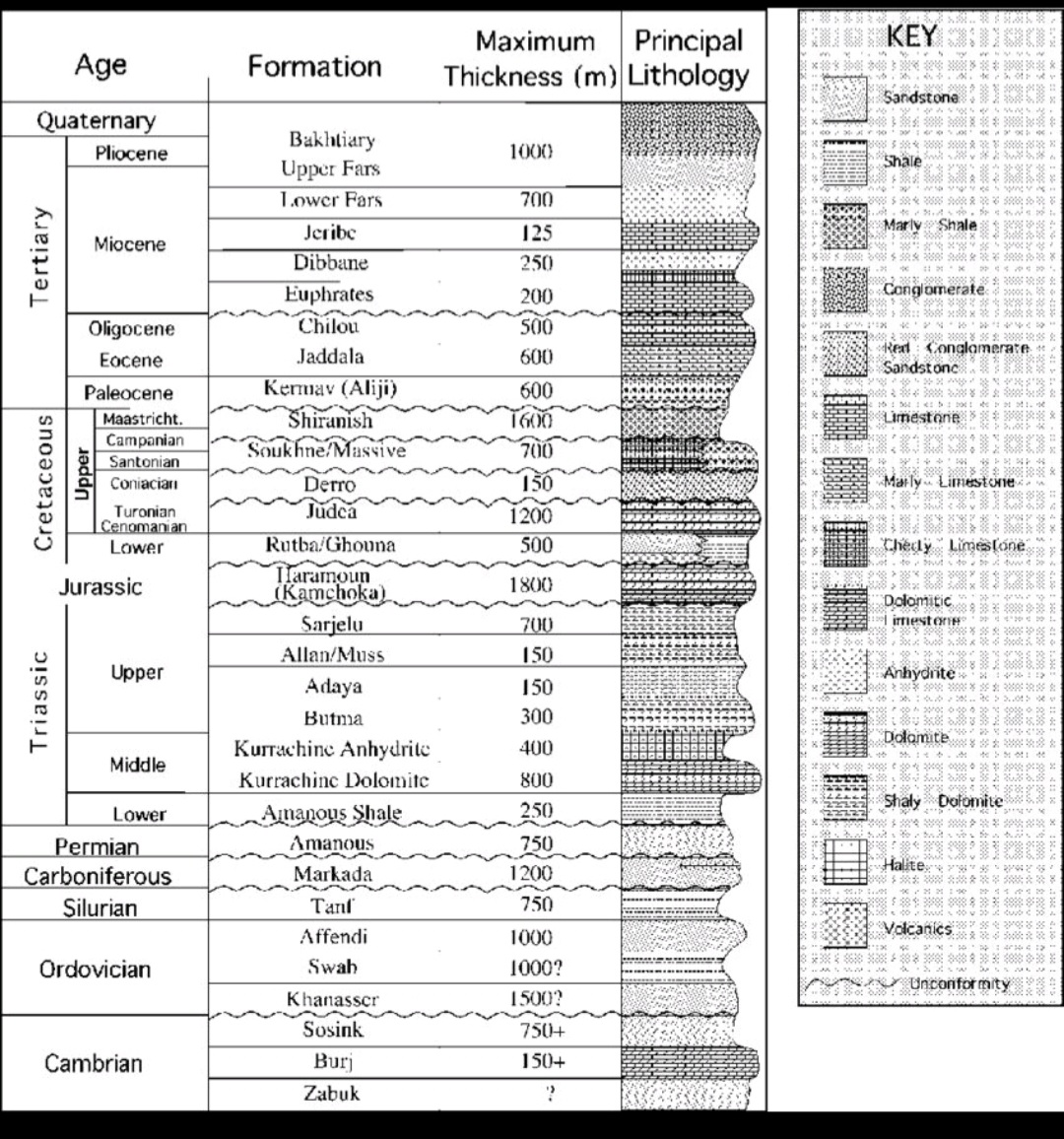
The stratigraphic succession in Syria ranges from Cambrian to Cenozoic and includes multiple petroleum system elements. Paleozoic siliciclastic sequences form important reservoir and source rock intervals. Mesozoic carbonate platforms and marine shales constitute key reservoir and source units, while Cenozoic clastics and shales provide additional reservoir and sealing capacity. Regional evaporites and thick shale units act as effective seals across several stratigraphic levels.
5. Petroleum Systems
Multiple working petroleum systems have been identified in Syria. Source rocks include Silurian organic-rich shales and Mesozoic marine shales that have reached thermal maturity within deep basins. Hydrocarbon migration occurs along fault systems and permeable carrier beds. Trapping mechanisms are predominantly structural, with additional stratigraphic and combination traps present in certain basins. Oil-prone systems dominate in shallower settings, whereas deeper depocenters exhibit gas-prone characteristics.
6. Exploration Plays and Potential
Exploration plays in Syria include tilted fault blocks, inversion-related anticlines, fractured carbonate reservoirs, and deep Paleozoic gas plays. Despite historical exploration, substantial potential remains in deeper stratigraphic targets, structurally complex regions, and underexplored basin margins. Advances in seismic imaging and basin modeling provide opportunities to reassess these plays.
7. Exploration Risks
Key exploration risks include structural complexity, uncertainty in fault seal integrity, reservoir quality degradation due to diagenesis, and limitations in seismic data quality. An integrated geological and geophysical approach is required to mitigate these risks and improve exploration success.
8. Conclusions
Syria hosts multiple proven petroleum systems within a geologically diverse setting along the Arabian Plate margin. While exploration has been successful in certain basins, significant hydrocarbon potential remains underexplored. Future exploration success will depend on improved subsurface imaging, refined tectonostratigraphic models, and focused evaluation of deep and structurally complex plays.
References
• AAPG Bulletin, regional petroleum system studies of the Arabian Plate
• Geological Society Special Publications on Middle East tectonics
• Regional stratigraphic and basin analysis studies of Syria