

Country Overview Series | Upstream Geology of Sudan
Author: Dr. Mohamed Basyouni Anwar
Global Geological Strategist | Exploration Oil & Gas (MENA Region)
Contact: mhmdbasyouni@gmail.com | LinkedIn
1. Introduction
Sudan occupies a key geological position at the intersection of the Central African Rift System and the Red Sea rift margin, hosting several Mesozoic–Cenozoic rift basins. These basins are filled predominantly with continental to shallow-marine sediments. Among these, the Muglad and Melut basins are the primary onshore petroleum provinces, while the Red Sea Basin constitutes a frontier region with significant underexplored potential.
2. Geological Setting and Regional Framework
The Sudanese sedimentary basins developed in response to extensional tectonics associated with the breakup of Gondwana and the subsequent rifting that formed the Red Sea. The onshore rift basins, notably Muglad and Melut, contain thick sequences of lacustrine and fluvial deposits conducive to hydrocarbon generation, migration, and entrapment. The Red Sea margin exhibits complex salt tectonics and pre-salt syn-rift sequences that provide potential for high-impact discoveries.
3. Major Petroliferous Basins
3.1 Muglad Basin
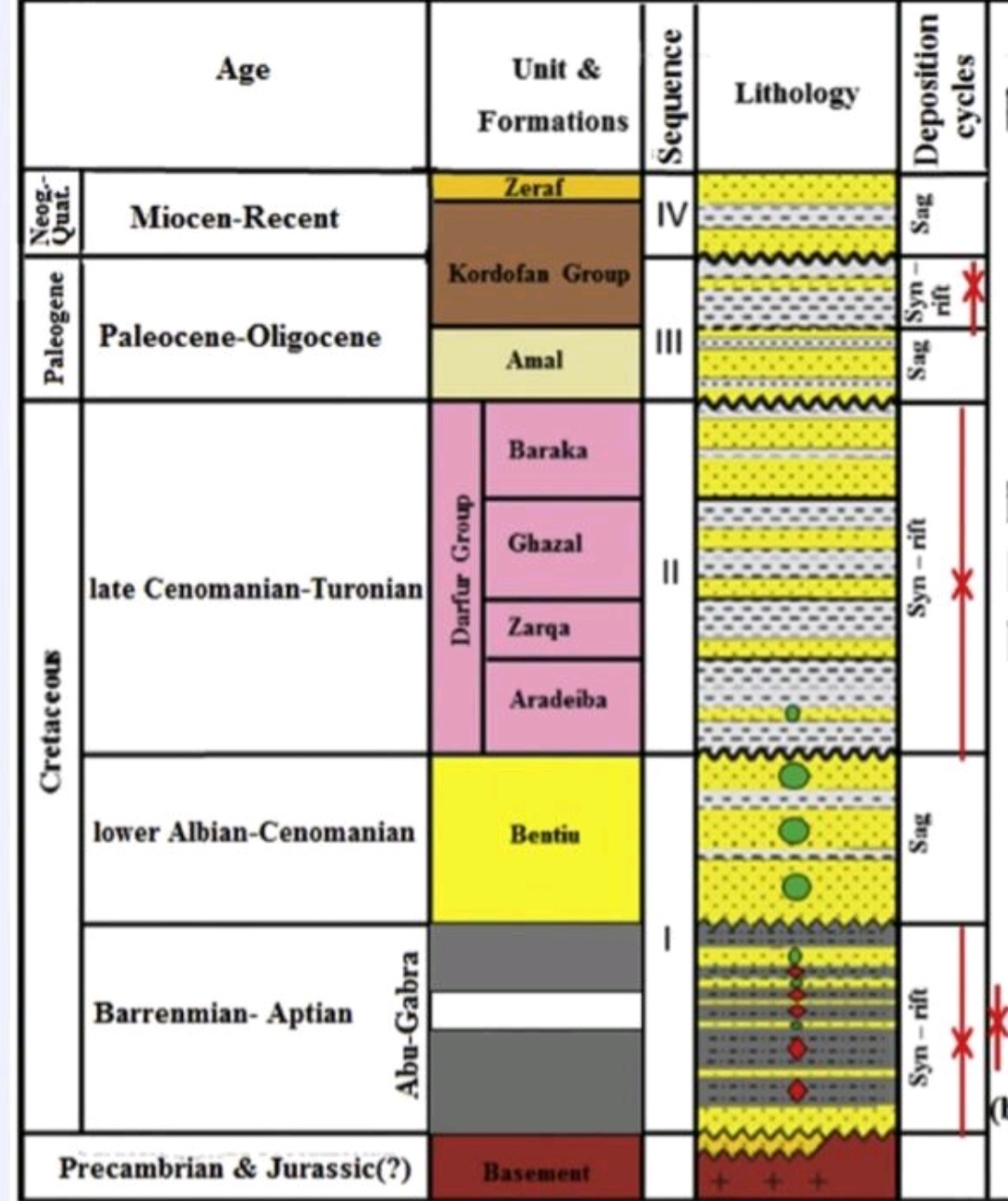
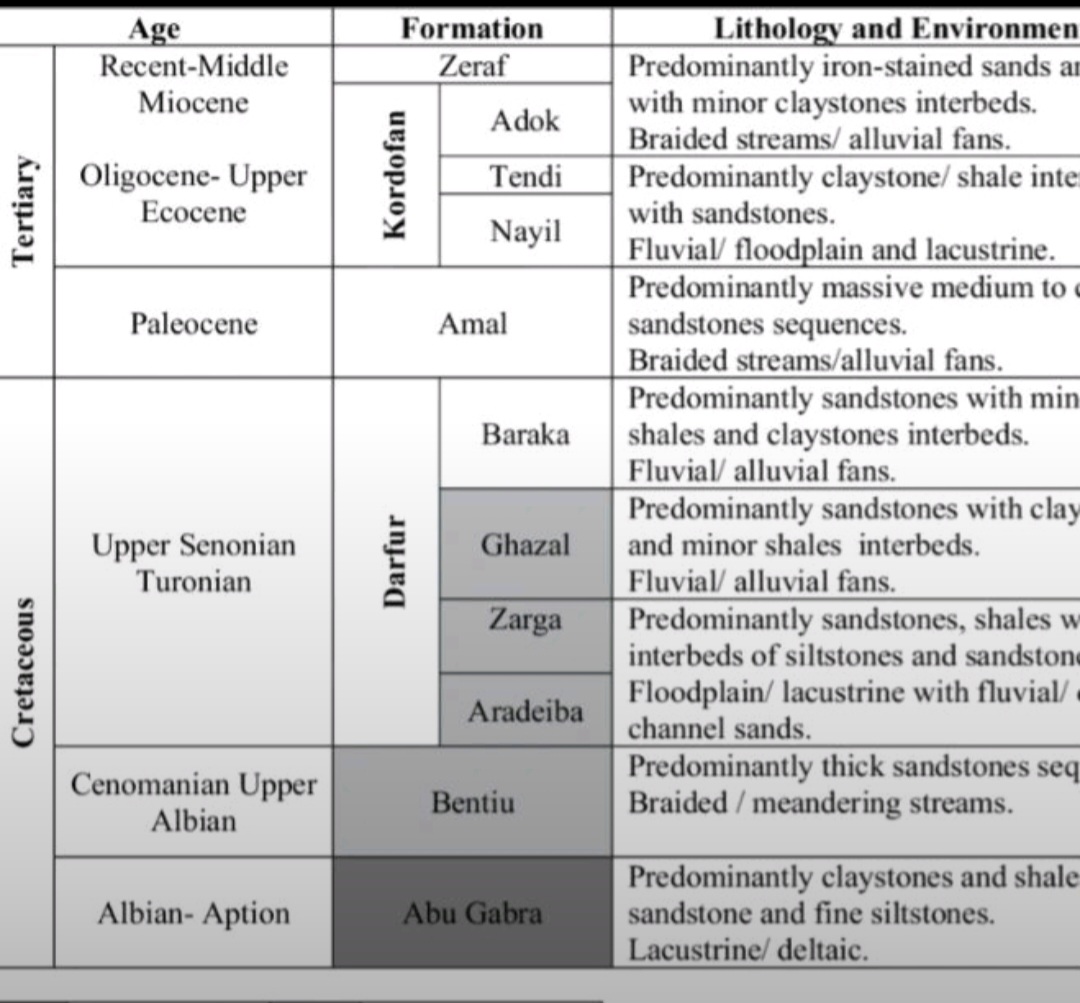
The Muglad Basin is the largest and most prolific rift basin in Sudan. It is characterized by thick fluvio-lacustrine sequences comprising well-established source rocks, reservoir sandstones, and effective seals. Principal trap types include faulted anticlines, tilted fault blocks, and stratigraphic pinchouts. Notable producing fields include Heglig and Unity.
3.2 Melut Basin
The Melut Basin lies east of the Muglad trend and extends into South Sudan. It contains high-quality lacustrine source rocks and excellent sandstone reservoirs. Key producing areas include Palouge and Adar. The basin is connected to the Red Sea export infrastructure via the Petrodar pipeline.
3.3 Red Sea Basin
The Red Sea Basin represents a frontier petroleum province with pre-salt syn-rift plays beneath thick Miocene evaporites. Salt tectonics have generated structural closures and mini-basins. Exploration is constrained by limited seismic coverage, and modern imaging is required to reduce technical uncertainty.
4. Exploration and Production Overview
Hydrocarbon exploration in Sudan began in the 1970s, with major discoveries occurring during the 1980s and 1990s. Oil export relies primarily on the Greater Nile and Petrodar pipelines leading to the Red Sea. Following South Sudan’s independence in 2011, many producing fields were lost to the new country; however, northern extensions of the Muglad and Melut basins in Sudan retain considerable potential. Current priorities include infrastructure rehabilitation and frontier basin evaluation.
5. Key Challenges
Several factors constrain hydrocarbon exploration and production in Sudan:
• Political and security instability affecting operations and investment.
• Limited recent seismic coverage, particularly offshore.
• Aging pipelines and refinery infrastructure.
• Technical complexity in imaging salt-influenced Red Sea targets.
6. Exploration Opportunities
Potential areas for exploration and development include:
• Onshore basins: Reprocessing legacy seismic data, targeting deeper fairways, and identifying subtle stratigraphic traps.
• Red Sea margin: Modern 2D/3D seismic acquisition to delineate pre-salt structures and salt-cored closures.
• Integrated basin studies: Combining structural and geochemical modeling to refine petroleum system understanding.
7. Conclusions
Sudan remains a geologically attractive yet operationally challenging exploration province. The Muglad–Melut rift trend offers immediate redevelopment opportunities, while the Red Sea Basin represents the country’s most promising underexplored frontier for potential high-impact hydrocarbon discoveries.
References
(Include here citations to key basin studies, regional reports, and peer-reviewed articles.)